
Intro Series XII: Personal Metabolisation I
Transforming both our sources of personal suffering and self-deception in one; expanding our capacity to be with and process bigger-than-self distress

Metabolisation of one’s personal material, one’s own “stuff”, or Big and little “T/t” traumas, could be seen as a kind of modern day entry point for the pathway to processing bigger-than-self distress, which is one way of recognising our interconnectedness with all things, particularly with the biosphere and society. Personal distress is not the only possible entry point, but recovering from the psychological harm and neglect done to oneself and getting a grip on who one is whilst participating in that healing process is a powerful avenue of growth for many.
Living in the modern world, under conditions of worsening meta-crisis, is traumatic for many if not most of us in some way or another. We may or may not link this consciously to the meta-crisis: the dominant paradigms in mental health treat mental illness as something that is located within an individual, and more specifically within their brain. This, in combination with a highly individuality-oriented culture in general, can obscure our interconnectedness in a thousand ways, including seeing mental distress in individual terms rather than being largely fed by bigger-than-self conditions. From my own clinical training and experience, there are clearly a great many cases where the paradigm of treating mental illness as an individual problem is at least partly true and/or useful, and it can afford the individual agency to gain tools and skills to participate in their own recovery, with or without the help of medications. And yet, the emerging perspective of a world in polycrisis and cultural meta-crisis changes this picture: it makes a lot of sense to feel traumatised or have some sort of dysregulated relationship with one’s emotions in a culture that often incentivises this and in a global situation such as we are in.
Without personal metabolisation, however, it is easy to simply accept the cultural norms as, well, normal: that we should be okay with it and something is wrong with us if we feel differently than that. We look around and everybody else seems to be accepting things as they are, even if they are silently or not-so-silently struggling with things. It takes a change of perspective, or experience of expanded awareness, often, to see that things that are culturally normal may not be healthy, and that these very conditions are contingent rather than inevitable. Working through trauma towards a more healthy relationship with one’s own stored psychological material brings about changes in one’s embodied cognition that then cause changes in how we perceive ourselves and things in bigger-than-self reality. These changes in perspective can be readily demonstrated by the Full Spectrum Collaborative Sensemaking Diagrams (Painton, 2024), introduced in Post X in this series, and shown below.
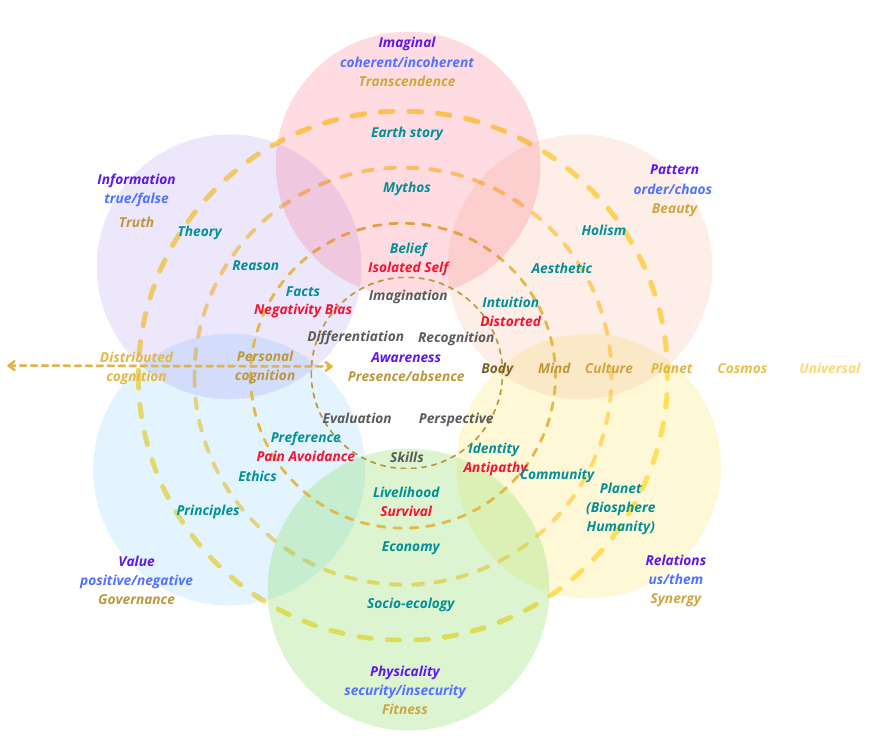
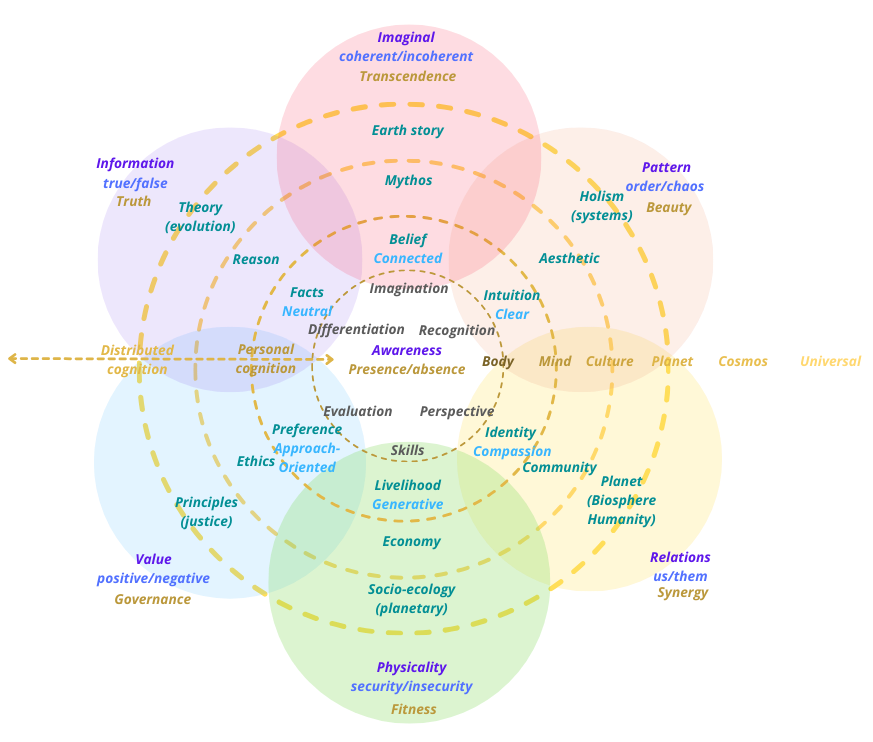
These Full-Spectrum Collaborative Sensemaking Diagrams above give a taste of some relevant differences between embodied awareness in a traumatised (Figure 1) versus healthy (Figure 2) state. As these diagrams are sensemaking tools, what is written in red or blue is up for debate and suggestions, rather than permanent and unchanging markers - but the red and blue qualities of embodied awareness at the Body level in Figure 1 and Figure 2 show the difference in affordances perceived in one’s environment when embodied awareness is in a (post-traumatic) stressed state or not. Note that this is making use of trauma in broad terms, both big “T” and little “t”, as this is what is processed in personal metabolisation processes such as those described below. In each of the domains, the diagrams demonstrate commonly observed, non-controversial effects of trauma or post-traumatic stress on embodied awareness in each category, alongside what embodied awareness naturally looks like when in a state of health or adaptive information processing.
Starting with Awareness, there is generally a tendency towards absence/contraction in trauma-affected processing, and a tendency towards presence/expansion in healthy processing. In the Relations domain, there is a tendency towards antipathy and judgment of self and others in trauma-affected processing, and towards compassion and non-judgment in healthy processing. In the Evaluations domain, there is a tendency towards avoidance of pain, movement towards superficial pleasure/comfort in trauma-affected processing, and a tendency towards approach of difficult emotions and towards deeper equanimity in healthy processing. In the Physical domain, there is often a focus on survival in trauma-affected processing, and on generativity in healthy processing. In the Facts domain, facts are processed with more of an in-built focus on negative emotions (or avoidance of these through fantastical/magical thinking) in trauma-affected processing, and more neutrally or even positively in healthy processing. In the Pattern domain, intuition is distorted in trauma-affected processing, and clearer in healthy processing. In the Imaginal (Belief) Domain, beliefs tend to unconsciously emphasise the individual self and its isolated, cut-off status in trauma-affected processing, while feelings of connection are more easily felt and recognised in healthy processing. Again, these are all up for debate, and are suggestive and contextual rather than being offered as permanent objective facts.
Situating embodied awareness within these Full Spectrum Collaborative Sensemaking diagrams shows how even at the personal (or “Body”) level of processing, trauma and its metabolisation or not profoundly affects one’s relationship to the world and shapes the kinds of actions that are afforded to one’s person when acting in the world. The above diagrams, for simplicity’s sake, leave blank what the ripple effects might be on the other levels of distributed awareness that flow outwards from the Body level (Mind, Culture, Planet, Cosmos, and Universal), but we can already see how embodied awareness that is affected by trauma is going to process reality differently to one that has metabolised that trauma in a healthy way. These broader layers will be covered in more detail in future posts, but suffice to say that we can understand a significant portion of the meta-crisis through the ripple effects of trauma in embodied awareness alone.
Turning Towards our Distress
It is important to recognise that these diagrams, by their nature, are necessarily an over-simplification. In reality, most of us have a mixture of healthy and trauma-affected processing that we may be more or less aware of in how it is affecting our perception of ourselves and the world in any given situation or moment in time. However, with the development of awareness, whether it be through therapy, mindfulness or related practices, or other means, we can become increasingly aware of potential areas of trauma-affected processing. Often, though, trauma-related material presents itself in ways that are difficult to ignore whether or not we are actively trying to develop our awareness. Whether the symptoms come in the form of a psychiatrically diagnosable disorder, physical health problems, relationship difficulties, or other problems of living, the effects of unprocessed trauma often announce themselves all too loudly in the form of suffering.
Our own suffering is arguably the hardest form of suffering in the world to ignore. And yet ignore it we often can and do, still. Ultimately it is a choice to turn towards our own distress and suffering that is required to move towards healing and recovery. This could take the form of choosing to go to therapy, see the doctor, make changes to our lifestyle choices, begin a meditation practice, or a multitude of other options. Most therapists and coaches will have tools and techniques that involve moving through something that is in some way difficult, avoided, or unpleasant, in order to get clients to the place they desire to go. It is a journey towards less distress in the long term that can involve a willingness to tolerate, accept, or move towards more distress in the short term. This journey is a fractal pattern, in that it shows up with each type of metabolisation: the willingness to move towards and skilfully process distress in the short-term in service of reducing distress to self and others in the long term.
Nonseparate Metabolisation
Metabolisation of stored forms of distress in embodied distributed cognition, in its essence, actually can be seen to follow a remarkably simple pattern. This pattern follows what is called the Law of Three, a principle proposed by 20th Century mystic George Gurdjieff, and recently re-articulated by Cynthia Bourgeault (e.g., 2013), which the following work owes a heavy debt of gratitude to. We could call the following the “basic metabolic equation”, and the resulting catalytic process “nonseparate metabolisation” as from what I can tell, it holds true across domains and levels of distributed embodied awareness. The basic form of this equation is as follows:
“First Element” [Embodied Experience of Distress / Dissatisfaction / Piece of Incoherence] + “Second Element” [Being With from Expansive Awareness / Self / Presence] + Third Element [Reconciling Force, Missing Catalytic Energy] = Fourth Element [New Creative Arising, Increase in Embodied Satisfaction, Increase in Bigger-than-Self Coherence]
A defining feature of both trauma-related and other patterned, ingrained forms of suffering and calcified conflict is that they are held in some way that leads to a sense of being stuck in time. Physically/neurologically, they are ‘baked into’ the structure of distributed embodied cognition and the way it relates to its environment - we can see this in the brains of traumatised individuals, who display structural changes in amygdala and hippocampus volume, which correspond to functional changes in cognitive and emotional functioning. Unlike the immediate pain that arises, for example, when one stubs a toe, ingrained forms of suffering are in some way woven into the structure of embodied cognition such that the suffering is maintained. This doesn’t mean the suffering will be at the forefront of conscious awareness in every moment - but the patterns that maintain depression, or an addiction, or a tendency towards uncontrolled anger in interpersonal situations, are reflective of structural patterns in distributed embodied cognition of the person and their relationship with their environment.
When such a pattern of suffering presents itself to awareness - in the form of distress in a given moment, we can relate to this as what is referred to as the First Element, or the Affirming. In the Law of Three, which in essence describes a pattern of creative unfoldment, the First/Affirming is often associated with a “seed” in that it has as-yet unrealised creative potential within it. As we will see, this in itself is a profound reframing of embodied distress, as what follows from framing distress in such a way is an attempt to transform such distress: to actualise the potential within it - rather than seeing it as a symptom that must be eradicated or removed. Certainly we want to experience something different, but the way we go about it is by welcoming it in, becoming more intimate with it - and this is where the Second Element comes in.
The Second, or Denying force in this Law of Three pattern, then, is Being With from Expanded Awareness / Self / Presence. From a contemporary psychological perspective, this is more or less equivalent to how mindfulness-based interventions approach distressing experience. We de-centre from the original experience, perceive it from a place in awareness that is more expansive, able to observe it with compassion, without reactivity, so it can be seen more clearly and other things about it can begin to be noticed. What is different in the Law of Three is that there is explicitly a Third, or Reconciling, force, that is needed to bring about transformation of the experience.
It is this Third Reconciling force that catalyses the process and leads to the alchemical metabolic transformation of the First, in combination with the Second, and lead to the Fourth, a new Creative Arising. This differs from many mindfulness-based approaches, which emphasise the First and Second, but then often stop there, leaving the individual with the task of continuing to monitor, nonjudgmentally and in the present moment, the experience of distress, and slowly “expand the container” so that the difficult material has more space around it, which can then help to dissolve it over time. This mindful awareness of experience does have an effect - it is a lot better than attending to the experience in a non-mindful way, but in my experience it does not on its own lead to the catalytic transformation and new Creative Arising. In my understanding, most eastern wisdom traditions that utilised mindfulness meditation did not stop there, and there were a lot of powerful investigative practices and tools that could be used by a mind prepared by mindfulness and other trainings.
What’s required for this catalytic transformation, in the method that I am most familiar with and am setting out here, is this as yet under-described Third Reconciling force. The Third force is difficult to describe because it is by its nature mysterious, contextual, something that arises in awareness from Self/Presence in such a way as to Reconcile the stalemate arrived at between the First and Second forces. It is not simply a compromise, but a thing newly perceived that leads to a catalytic transformation of the First and Second. Examining some prototypical Law of Three example arrangements may help us to start to get at the nature of this Third Force. Bourgeault (2013) lists the following examples of first/second/third -> fourth arrangements:
seed/earth/sun -> sprout
flour/water/fire -> bread
plaintiff/defendant/judge -> resolution
sails/keel/helmsperson -> course made good
We see here that (a) the law of three, as it is discussed within the lineages it comes from, applies over a wider range of situations than psychological material; but more to the point, that (b) how the Fourth is not simply a combination of the First and Second but requires the Third to reconcile the tension between the two. Getting to or perceiving this Third as it plays out in this nonseparate metabolisation process is not necessarily a straightforward path or a short distance. It may require further embodied introspection to get to the bottom of the parts/memory networks/reactivity involved. It may require input from other people, new learning from the environment that plugs gaps in current knowledge or allows for a needed re-frame or set of re-framings.
What seems important to say about the Third is that there is usually a thread that can be sniffed out, sensed, and followed that leads one there. Almost always it seems to require us to let go of our habitual left-hemispheric “thinking” mind and to re-perceive from Self/Presence holistic sensing, which includes thinking but is not limited to it. To do this holistic sensing of the Third well requires specific attunement in one’s enactive relevance realisation processes that plays out in one’s participatory and perspectival knowing. These skills in participatory and perspectival relevance realisation are often best learned in relationship, for example with an experienced guide, mentor, coach, or therapist, or in a group environment led by someone who has developed sufficient competency in these wisdom skills.
Another thing to say about the Third, and this whole nonseparate metabolisation process, is that it is not merely confined to the individual psychological realm. Without at this point going into metaphysical rabbit-holes, the Law of Three unmistakably originates itself in mystical wisdom traditions. It is here that the work done earlier in this Intro Series building up the cognitive grammar of enactivism, distributed cognition, and models of Bigger-than-Self Reality such as Big History and the ToK system start to come to the fore. Because complex human (cultural) cognition can be seen to emerge from evolutionarily earlier and less complex levels of reality (e.g., physical, biological, animal), we can perceive existing a fundamental continuity between complex cognition and the structure of reality itself. The structure of relevance realisation in cognition and culture mirrors the structure of behavioural selection in animal cognition, the structure of the evolution of species in biology, and the structure of self-organisation in physical reality.
This earlier grounding in a cognitive grammar that sees this deep continuity between cognition, life, and reality, as well as the understanding of distributed cognition from enactivist cognitive science, affords us to entertain the notion of relevance realisation being intimately connected with the structure of reality itself, and this process being able to move out of its confinement in the brain where Western thought has locked it away since the time of Descartes. All this is to say, (1) the Third is not confined to the brain: obviously the brain is involved in its perception, but the perception can come from any aspect or level of Reality itself; and (2) the nonseparate metabolisation is not confined to the individual’s cognition, but can fan outwards to influence the wider networks of distributed cognition within which it is embedded. This may indeed raise more metaphysical questions for some, and that may be a fruitful topic to go into in future, but from an intuitive, participatory relevance realisation perspective, these questions are secondary, questions for the left hemisphere. For now, let us simply say that this metabolic process that unfolds within awareness seems to operate within different domains and levels of distributed cognition and nonseparate reality, but that our focus for the time being is on the personal.
Personal Metabolisation
Personal metabolisation refers to metabolisation of issues that have to do with oneself personally, and one’s own individual life and history. This includes most issues commonly brought to therapy, or in increasing numbers of cases, to personal coaching contexts - for example, attachment (e.g., Cassidy & Shaver, 2008), family of origin (e.g., Cepukiene, 2020), self-concept (e.g., Kuhar & Zager Kocjan, 2021; Wong et al., 2019), Axis I and II mental disorders (American Psychiatric Association, 2013), cultural, gender and sexual identity issues (e.g., Churcher Clarke & Spiliadis, 2019; Ibrahim & Heuer, 2016), relationship with food and/or consumption habits (e.g., El Ansari et al., 2014; Hunecke & Richter, 2019), career and vocation (e.g., Shackell, 2022). In the context of personal distress in relation to the bigger-than-self world and meta-crisis, personal metabolisation can also include a focus on issues to do with life and existence within systems as they currently exist, such as securing a livelihood, participating in family and social life, and fulfilling important commitments within the world as it is.
The therapeutic / self-unfolding approaches discussed so far in this Intro Series (mindfulness-based interventions and MiCBT in Parts I and II, IFS, Aletheia Coaching, and EMDR in Part VII) are all transdiagnostic interventions. That is, they work in broadly similar ways across a range of different issues that people present with. A shared underlying logic that these each have is their being mindfulness-based: involving sensing into present experience and working with the somatic (body) sensations, affect, and cognitions that are arising in awareness in the present moment, even if that content is about things that are in the past or future, or abstracted from the immediate present-moment environment.
This common underlying logic means that for any one of the issues outlined in the previous paragraph, a similar set of principles can be applied to metabolise experience. That is, one can sense into the issue at hand, formulate a list of things that are brought up by that cue, and then proceed to working through and investigating in more detail each item on the list, according to the therapeutic or coaching modality being employed. Parts-based approaches investigate the part or parts of the internal system that are involved in that aspect of one’s life; EMDR primarily investigates the memory networks and history of unprocessed experiences associated with that issue; while MiCBT would look deeply into the co-emerging body sensations and cognitions that arise when attention is turned to that issue.

All three modalities then have broadly similar (though not identical) emphases in how those problems are then ideally worked through, or what the ideal outcome looks like. In parts-based approaches, the ideal is to become more Self- or Presence-led over time: for one’s parts to form tight relationships with Self/Presence and be guided by the naturally occurring values of the Self (i.e., the 8 Cs of compassion, courage, creativity, clarity, curiosity, connectedness, calm, confidence, and 5 Ps of presence, persistence, perspective, playfulness, and patience). In EMDR the idea is to be operating increasingly from resourced, adaptive memory networks that are unburdened by unprocessed small and big t/T traumas and are represented by the adult self. In MiCBT, the goal is to become increasingly equanimous with, or unperturbed by experience, while remaining in intimate connection with it, and to continually perfect the “10 perfections” (generosity, virtuous intent, renunciation of non-wholesome activities, wisdom, effortfulness, patience, truth-oriented, determination, kindness, and equanimity). Importantly, for all three modalities, this is a continually unfolding or developmental trajectory that can be applied to one’s life beyond treatment of the initial issues at hand.
What Changes in Personal Metabolisation?
What is being suggested in the notion of personal metabolisation is that in these modalities and others like them, there is a process at play that allows one to process or metabolise the material that comes up for an individual when grappling with an issue. This metabolising happens through giving a certain kind of attention to the issue as it arises in awareness, and leads to an often gradual, sometimes dramatic, shift in perception and understanding of the issue and how one is relating to it (usually when the Third Force is identified). If this process is continued, and applied to more and more sources of stuckness, confusion, or distress, it naturally deepens, and deeper and broader changes in one’s perception and sense of self can and do often occur. This is what I have referred to in earlier posts, particularly when talking about enactive wisdom development, as structural changes in one’s embodied cognition: stick with these processes for long enough and your very self (your participatory and perspectival knowing, to use Vervaeke’s language) will change, in ways that are associated with structural changes in the physical brain and its patterns of networked connectivity.
Who we are changes through the process of metabolisation. This is described by many people who go through these changes as a moving towards oneself, however - a seeing more clearly or having revealed who one actually is (the emerging Fourth Element) behind all the noise of one’s automatic or habitual impulses. This includes, for many who follow the path long enough and with enough dedication or luck, the nondual experience. The nondual experience can be described in many different ways but from a majority of descriptions seems often to involve in some way a seeing through of one’s individual, separate self into a deeper unity or nonseparation from the rest of reality, other people, or other aspects of the bigger-than-self world. One realises, experientially rather than intellectually, one’s interconnectedness and continuity with all existence generally, and potentially with certain processes of being/Reality in particular (this last point will become more relevant and discussed more in the next post on psycho-cultural metabolisation).
What is metabolised in personal metabolisation, then, is patterns of reactivity and distress that cause problems and suffering for us as individuals and our relationships with others and the world. The results of this metabolic process seem to be insight, clarity, increased connectedness, compassion, wisdom, eudaimonic meaning, ability to be equanimous with different experiences, and creativity and confidence. These are obviously highly valuable commodities - but of course they are not commodities, but modes of being, which one participates in and with. This is why the phase shift being pointed towards in this approach is one away from the “having” mode to the “being/becoming” mode - we already have the technology, intellectual knowledge, political know-how to solve the world’s problems: the issue that this phase shift seeks to address is one of being and becoming the individuals and the culture that will see the right things as relevant at the right times to actualise wise and coherent (or, to start with, less foolish and less incoherent) responses to the pivotal crises of our time.
Subtle Changes Occurring Below the Propositional Level of Awareness
There are subtleties to the changes being discussed here that occur within personal metabolisation that easily slip under the radar of automatic, habitual modes of being. Without sufficient awareness, nourished frequently by wisdom-oriented practices, we can easily get seduced by narratives (including/especially our own) about what is happening and miss what is actually happening. This is another instantiation of the intellect-embodiment gap. What IFS refers to as manager parts exist, in part, to protect our own views of the world and ourselves (or to reduce surprise / minimise predictive error as per the Free Energy Principle as discussed in Intro Series VII), and this is much more easily done by narrative manipulation than by behaviour change. For example, parts of us can have us act on urges in ways that are not in alignment with our deepest values, then other parts can come in to reassure the narrative self that it wasn’t our fault, or wasn’t actually that bad, or it was just this one time, etc.
What I’m pointing towards here is not about being a good or bad person, but instead about the quality of our attention and actions, which many wisdom traditions (especially Eastern ones) show us works best when we discard or see through the notions of good or bad or even a reified sense of self that is made into a permanent “thing”. Mindfulness and related practices allow us to see through these automatic narratives and reifications into a closer view of reality itself. Over time, these practices become self-reinforcing in a virtuous way: we become more and more interested in ways in which we are not mindful, not in integrity, and this wholesome motivation feeds into wanting to more deeply see and causally understand our behaviour towards ourselves, others, and the world. What gets metabolised is those aspects of our being that are not truly interested in that, which are revealed to be not truly us anyway. What is left is the calm, courageous, creative, connected self-as-process, aware of and acting within an embedded web of relations in the world.
Example: The “Good Girl” and the Meta-Crisis
To illustrate what the above might look like with a relatively benign case example, imagine a woman with a relatively stable upbringing with attentive, loving parents who gave her a lot of praise for being a “good girl” - which was whenever she achieved well at school or extra-curricular activities or helped out other people, did altruistic acts, or put a lot of effort into her valued goals. In “normal” circumstances (a fantasy world that is not in meta-crisis), this woman might grow to be well-adjusted, making contributions in her job and community, and enjoy a stable and loving relationship with her partner and, if she so chose, be a caring, attentive, loving parent - and that might be enough for a happy and fulfilling life within the culturally normal understandings of reality. In actual reality, she might be halfway through this life before she starts noticing signs of the meta-crisis that is unfolding despite our propositional narratives of how we were brought up to think that reality/society/the world is supposed to be.
The beginning of this noticing of (at least part of the) meta-crisis and the concurrent bigger-than-self distress that it emerges with might initially be processed by the woman’s embodied cognitive system as a threat, but also opportunity: to be an “extra” good girl, and try even harder to live out a valued life, set goals related to reducing carbon emissions, protecting biodiversity, reducing/fighting prejudice or societal polarisation, or any one of a large number of worthy causes. Perhaps this even appears to “work”, externally, or for a time - but the woman notices that even though she is successful in achieving her goals, the world continues to degenerate in the areas that she is most concerned about. At the same time, she starts to notice that there is some part of her being that remains untouched by all the hustling she is doing externally in the world of business/politics/agriculture/parenthood/whichever industry or field of human endeavour she is engaged in. This part remains equally disturbed and increasingly despairing: she is being such a great “good” girl; why is it not helping with this creeping sense of existential despair she’s feeling?
Over time, such a pattern might continue, with increasing nagging hopelessness, increasing doubling down on setting goals and working hard to achieve them, increasing “success” in creating “impact” in the world. But as this pattern continues and potentially escalates, one of a number of things might happen that would indicate her received embodied cognitive system is not actually handling the bigger-than-self distress optimally: (1) very often, this pattern would lead to burnout, and an inability to carry on; (2) potentially, she would be able to carry on, but balls would start to get dropped in important areas of her life - maybe she works so hard that her relationship with her partner deteriorates, or she is not able to maintain her health, or she develops a drinking, drug, or any number of maladaptive habits to cope with the increasing pressure she is putting on herself; (3) the way she is processing the world, which under ‘ordinary’ circumstances would be totally adequate, starts to cause distortions in the work she is doing itself due to the increased pressure of bigger-than-self distress - for example, she becomes so hyper-focused on impact that she treats staff underneath her badly, becoming tyrannical in service of “the cause”, or starts to become bitter towards an imagined ‘out-group’ that is linked to the problems that she is fighting against.
I have seen such examples play out in numerous well-meaning individuals - for me, it’s mostly been patterns of burnout, isolation, and physical health issues that have been the signs of maladaptive coping. Again, this isn’t about judgment of any one individual being good/bad but being clear on why deep practices for personal metabolisation are needed in responding coherently and effectively to the meta-crisis and its symptoms. Personal metabolisation would focus attention on those aspects of the person’s being that are in distress due to bigger-than-self issues, and help them process the excess emotional reactivity that is associated with that. In doing so, this would open up new ways of perceiving the situation that were not previously perceivable to her, or accessible through intellectual thought alone. The embodied affective reactivity associated with the (relevant aspects of the) meta-crisis would come down, and progressively transform into a kind of equanimous resolve to act coherently in response to the challenges represented by such issues that is sustainable over time. There would be an increasing ability to balance such demands with other important demands in life, and accept that whatever she does, it will not be “enough” (on its own) to solve the bigger-than-self issues she is concerned with. But this is not all: there might be creative insights and breakthroughs (“Fourth Elements”) that were not foreseeable at the beginning of the process, and which are hardly describable here. My own path of metabolisation has certainly unfolded in ways that I could not have predicted ahead of time.
Circling Back: Returning to the Need for Metabolisation of Bigger-than-Self Distress
In the last post, I outlined the reasons why metabolisation of bigger-than-self distress was essential for anyone seeking to make lasting, beneficial contributions towards mitigation of and adaptation to the meta-crisis. Having now discussed personal metabolisation work in more detail, we can now return to this, which I view as a central point to try and communicate in this series. The “good girl/boy” is a common archetype in our globalised culture, which is heavily influenced by the (institutional) Christian heritage of Western civilisation.
Christian values of charity, loving one’s neighbour, and also Christian judgement of sin and the fear of eternal punishment have contributed to a sharp divide in Western culture between “good” and “bad”, where it is psychologically untenable for many of us to think of ourselves as “bad”. At the same time our shared deep psychological history also has us seeing our basic natures as being irredeemable sinners, which is often expressed nowadays through unrepentant inner critics. This is baked into much Western culture, to a degree in which I would hazard to say that even most non-Christian Westerners today still subconsciously subscribe to this basic psycho-cultural structuring. This particular Christian heritage interacts with perennial vulnerabilities to self-deception that are seemingly inherent to the human condition, and produces a vulnerability to psychological blindspots whereby we maintain personal and collective narratives of being “good, and not bad”.
Mindfulness, non-judgment, seeing the self as made up of parts that are essentially good (as in IFS and Aletheia Coaching), and embodied trauma-reprocessing techniques such as EMDR, are all effective modalities that have proved popular in therapeutic and coaching contexts. Central to all of them is a method that can, in gentle, caring ways, bring these blindspots and inconsistencies in our narratives of ourselves, or in self-deceptive loops that have us acting in ways that we would prefer not to, into awareness. Once in awareness, these self-deceptive loops and the conditions that lead to these lapses in integrity can be metabolised. Much of this takes place beyond (or underneath) the propositional mode, the narratives that we have about ourselves and the world. It is difficult to see a way around these kinds of wisdom-developing, metabolic practices and tools being needed for individuals and collectives who wish to respond effectively to the meta-crisis and the interconnected set of cultural and environmental crises of our time.
At the same time, this need for metabolisation does not need to be received as grave news. It is serious, yes, but speaking to the need for metabolisation also points to the opportunity in it. Wisdom traditions and modern psychology and cognitive science are combining to reveal and give birth to powerful modalities of healing and wisdom development that have the potential to make our lives a lot better, on individual and collective levels. So yes, these practices are necessary if we are to face up to the seriousness of our times - but they are also good for us in the long run (and often short-run, too), and feel good to integrate, at least in the long term if not in the short-term.
Starting with personal metabolisation makes sense because this is already quite culturally normative; it leads to tangible benefits that are felt and experienced within one’s own life; and it both frees up capacity to engage in and leads to greater awareness of bigger-than-self distress and the meta-crisis. However, there is a broader point here, too, which tends to emerge as an experiential insight for at least some people that go through this process, and which is pointed to well by March (2021) in his discussion of Aletheia Coaching. This broader point is that this process of mindfulness-based trauma healing and metabolisation leads to a kind of autopoietic self-unfoldment. The old self is metabolised, but it is not simply deleted like an old computer file: it forms the compost or raw material which then is free to take on new (“Fourth/Arising Element”) roles. The inner critic becomes the inner agent of self-love, once it realises on an experiential, participatory level that behind all its judgments was a beneficent intention of loving the self (or of the parent, now internalised, loving the self) and wanting it to do well.
Another insight or set of insights that can slowly dawn through this process is that this kind of healing and metabolisation doesn’t only apply to personal material. When we go deeply into the embodied psychological roots of our own trauma, we usually find that it is not only ours, not only to do with experiences of our own lifetime. I can trace the roots of my trauma to experiences in my childhood, for example - but then those experiences are related to things that happened in my parents’ families of origin, and those experiences in turn were in large part created by my grandparent’s experiences in the Great Depression and WWII.
These deep embodied psychological patterns, which govern so much of our behaviour and how we perceive ourselves and our relationship to others and the world at large are greatly influenced by intergenerational and cultural events and trauma. And similar processes of autopoietic metabolisation, healing, and unfoldment can be practised with these. We can metabolise intergenerational and cultural wounds, and unfold new intergenerational and cultural patterns that become, with time, our legacy for future generations and inform and afford our contributions to the culture around us. My label for this process, which at its best is informed and steered by powerful and relevant wisdom traditions, is psycho-cultural metabolisation, and it will be covered in a future post.
For now, I thank you for reading and I hope that this discussion of personal metabolisation has been worthwhile for you as a reader.